


.svg)
Performance- First
Assets optimized for Amazon's algorithm: images, titles, and A+ modules tuned for CTR and conversion.
Automate high-converting images and A+ content to build faster and scale your Amazon listings effortlessly.
curl -X POST https://api.listingoptimization.ai/public/v1/campaigns \
  -H "Authorization: Bearer lo_live_YOUR_API_KEY" \
  -H "Content-Type: application/json" \
  -d '{
    "asin": "B07XJ8C8F5",
    "country": "us",
    "generate_main_images": true,
    "generate_secondary_images": true
  }'







Assets optimized for Amazon's algorithm: images, titles, and A+ modules tuned for CTR and conversion.
Cut listing time from days to seconds. Automate your creative pipeline with one API call.
Handle 10,000+ listings with 99.9% uptime on distributed infrastructure.
Save brand kits once; keep colors, tone, and style consistent across your catalog.
Link your catalog, upload product data, or start from an ASIN so the platform has the context it needs.
Choose the asset types, brand rules, marketplaces, and optimization goals for each listing workflow.
Generate ready-to-review creative, copy, and A+ content that is structured for Amazon performance.
Track what improves conversion, update underperforming assets, and keep every listing moving forward.
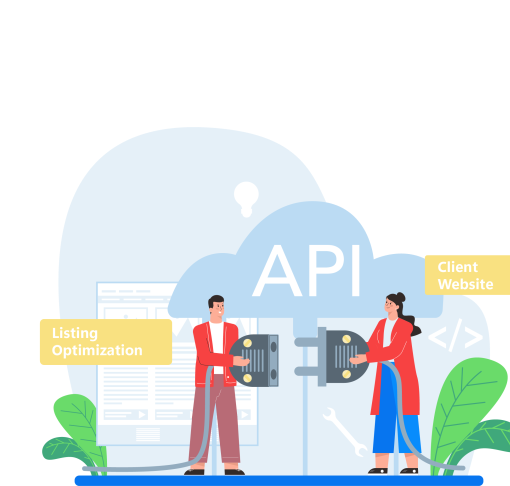
Send a product ASIN, let the AI analyze reviews, keywords, and competitors, and receive high-converting listing images and A+ content, ready to use in your app.
Generated in 34 seconds
Generated in 34 seconds
Each action enhances your product listing with meaningful improvements.
Tailored solutions for high-volume platforms and large organizations. Get dedicated resources and custom models fine-tuned to your exact needs.


.svg)
Everything you need to know about creating Amazon listing creative with Listing Optimization AI.
Listing Optimization AI turns an ASIN or a product photo into finished Amazon creative, backed by real market research. It analyzes your competitors and your category, builds the creative strategy, then produces main images, infographics, lifestyle scenes, A+ content modules, and listing copy.
Before you publish, you can preview your main image on a simulated search results page, compare your listing against competitors slot by slot, A/B test and check how ready it is for Amazon's AI shopping assistant. Every image is editable, ready to upload, and can be pushed straight to Seller Central through the built-in connection.
Amazon sellers, brands, and agencies who want listing creative that is built to convert, without hiring a designer or waiting weeks on an agency.
It works for a solo seller launching a first product, a brand managing a full catalog, and an agency running creative for dozens of clients. If your images and A+ content decide whether shoppers click and buy, it is built for you.
The images are ready to upload. Sellers take the output from Listing Optimization AI straight to Seller Central through the built-in connection and never open a design tool.
If you do have a designer or an in-house team, you can hand them the files along with the creative strategy behind each concept and let them push it further. That is an option, not a requirement.
Paste one ASIN into Listing Optimization AI and you get a full research and creative set:
The whole set generates in around 13 minutes. The research is the part people underestimate. Every image concept is built on top of it, which is why the output reads like it came from someone who actually knows your buyer and your competition.
No. Listing Optimization AI has no prompts to write and no settings to learn. Paste an ASIN or upload a product photo and the tool handles the research, the creative direction, the layout, and the output.
If you can use Seller Central, you can use this.
Listing Optimization AI is built by AMZ One Step on 10 years of Amazon agency experience. The founders bring more than 30 years of combined Amazon creative experience, and the strategies inside the product come from work done for 4,000+ brands.
That is the difference. This is an agency's research and creative process turned into software, not a generic AI tool pointed at Amazon.
Market Intelligence is the research layer underneath everything Listing Optimization AI produces. Before a single image is generated, it pulls your listing, your top competitors, and your category, then breaks down:
You can read it on its own as a competitive brief. It is also the input every image concept, A+ module, and line of copy is built from.
It finds them for you. Enter your ASIN and Listing Optimization AI identifies the listings you actually compete with in search, not just the biggest brands in the category.
You can add competitors you already track by ASIN, run a deep search to widen the set, and refresh Best Seller Ranks to see who is gaining and who is slipping.
For each competitor you see their image stack, the claims they lead with, the objections they answer and the ones they ignore, and what their reviews say they get wrong.
Then it rolls that up into a category view: the messages everyone repeats, the angles nobody owns, and the specific opening for your product. That opening becomes the brief for your creative.
Listing Optimization AI reads your reviews, your competitors' reviews, your category, and the listings currently winning in your search results. It shows you what the top sellers are doing well, what they are leaving on the table, and where the opening is for you.
It is not an opinion. It is a read on what is already live in your category.
SERP simulation shows your main image inside a simulated Amazon search results page, at real thumbnail size, next to the competitors you are actually fighting for the click.
You see what a shopper sees on a crowded page before you publish, so you pick the concept that stands out in search, not the one that looked best full screen on your monitor.
Shelf comparison puts your full image stack side by side with your competitors', slot by slot. Main image against main image, infographic against infographic, A+ against A+.
It shows where you are behind, where you are level, and where you have the edge, so you know exactly which images to replace first.
Every concept comes with the reasoning behind it: which buyer pain or objection it targets, which competitor gap it exploits, and why the layout is built the way it is.
It is the brief an agency strategist writes before a designer touches anything, and it makes the output easy to defend when you hand it to a client, a designer, or your own team.
A/B testing is built in, so you can put concepts head to head and let shopper behavior decide instead of opinion.
What Listing Optimization AI changes is the quality of what you test. Every variant is built on review data, category analysis, and patterns from thousands of winning split tests, so you are choosing between strong candidates instead of whatever felt right that week. Better inputs, higher hit rate.
More shoppers now ask Amazon's AI shopping assistant questions instead of scrolling, and the assistant reads your images and copy to answer them.
The Alexa shopping readiness score measures how well your listing answers the questions buyers in your category actually ask, compares your image coverage against competitors, and shows which missing images or claims would close the gap.
Both. Alongside your main image and gallery, Listing Optimization AI builds finished A+ content modules from the same Market Intelligence and creative strategy behind your images.
The modules are designed as one seamless set, not a stack of disconnected banners, so the story a shopper sees in your gallery carries straight through to the brand content below it. Like every other asset, each module is fully editable and ready to upload.
Yes. When a competitor has an image that is clearly working, pick it and Listing Optimization AI rebuilds that layout and idea with your product, your brand, and your claims.
You get a structure that is already proven in your category without copying their product, their photography, or their text. It is a starting point you make your own, not a copy.
Listing Optimization AI is a full listing toolkit, not a single generator. Alongside the image generator you get:
Market Intelligence is the one to start with. It tells you where your current listing is losing to competitors before you generate anything new.
General AI tools make pictures. They do not know what an Amazon main image has to do, and they know nothing about your competitors.
Listing Optimization AI is built for Amazon specifically. It researches your market first, knows the main image rules, designs for how the image looks at thumbnail size in search results, and outputs finished, editable assets at the right specs instead of something you have to repair before you can use it.
It has also learned from thousands of winning experiments that AMZ One Step has gathered over 9 years from Manage Your Experiments and other split testing tools. So it knows which images actually win clicks and sales on Amazon, not just which ones look good. With a general tool you are prompting and guessing. Here you start from what has already been proven to win.
All of the leading image generation models are available inside Listing Optimization AI, so you are not locked into one engine's strengths and blind spots.
Use the model that suits the job, whether that is photoreal lifestyle scenes, clean text-heavy infographics, or precise product edits, and get access to better models as they ship without paying for separate subscriptions.
That is the entire point of it. The creative strategies inside Listing Optimization AI come from work AMZ One Step has done for 4,000+ brands, and sellers using it report an average 27% increase in conversion rate.
Your main image decides whether anyone clicks. You pay for every one of those clicks, so what happens immediately after the click is where the money is won or lost. This is built to improve both ends.
Every image is fully editable. Change the text on an infographic, swap a background, adjust a single element, or regenerate one concept without touching the rest. You can also export the files and finish them in your own design tool.
Nothing is locked. If a concept is 90% right, you fix the 10% instead of starting over.
Yes. The first draft is a starting point, not a ceiling. Generate more concepts with AI, or pick from 100+ winning templates, in just a couple of clicks.
Keep generating until you have the set you want. Every new image is built on the same Market Intelligence and brand kit, so it stays on strategy.
Yes. For any image, Listing Optimization AI automatically suggests different ways the same image can be generated, so you are never stuck with one take on an idea.
Pick the directions you like and generate them side by side. It is the fastest way to get fresh versions of a concept to test without starting from scratch.
The AI edit copilot reviews every image Listing Optimization AI generates and recommends what could be improved, with the right prompt already written for you, so you do not even have to think about it.
Alongside each image you get recommendations like new copy ideas, new ways to present the product, and reimagined versions of the concept. Apply the ones you like and keep moving. Creative teams scale much faster and never hit creative fatigue.
Yes. Add your colors, fonts, and logo once and every generation from Listing Optimization AI stays inside them. It can also fetch the branding from your website, or you can use branding from your previous campaigns.
This matters most when you are working through a full catalog, because consistency across listings is what makes a brand look established instead of assembled one SKU at a time.
No, and this is worth understanding properly. Listing Optimization AI does not drop your product into a shared template. Every concept is generated from your reviews, your brand kit, your category, and the specific gaps in your competitors' listings.
Two sellers in the same category get different output because they have different buyers complaining about different things. The analysis is what varies, so the creative varies with it.
Yes. Every concept, layout, and output in Listing Optimization AI is built against Amazon's image requirements:
The secondary images follow every Amazon guideline too, such as prohibited keywords and false claims.
One thing worth knowing: any AI can get a product detail wrong, so give the output a quick look before you upload. The image has to match what is in the box.
No. Amazon permits AI-generated imagery and ships its own AI creative tools inside the advertising console. What Amazon enforces is accuracy and policy compliance, not how the image was produced.
The rule that matters is simple. Your images have to truthfully represent the product you ship. Listing Optimization AI is built around that constraint, which is why the main image stays on pure white and the infographics avoid claims that would get a listing flagged.
Yes. Everything you generate with Listing Optimization AI is yours.
Use it on your listings, in your Sponsored Brands and Sponsored Display ads, on your own store, on social, anywhere you want. No extra licensing fee and no restriction on commercial use.
Yes. The connection uses Amazon's official authorization flow, so you approve access inside Seller Central and you can revoke it there at any time without contacting us.
Listing Optimization AI uses that access to read your catalog and to publish images you have approved. Your login credentials are never seen or stored, and nothing reaches a live listing unless you choose to publish it.
No. Connecting is optional and it exists only to save you the download and re-upload step.
You can run Listing Optimization AI by pasting an ASIN or uploading a product photo, then download the finished files and upload them yourself on your own schedule. Everything works the same either way.
Supplements, beauty, kitchen, tools, electronics, baby, pet, home, outdoors, apparel, and more.
Listing Optimization AI reads your category and adjusts the creative direction to it, because what sells a supplement is not what sells a power tool.
It still works. Start the campaign using your main keyword.
When your listing has no review history, Market Intelligence builds the customer avatar from your competitors' reviews and your category instead.
For a launch that is arguably the better position to be in. You are designing against what buyers in your category already complain about and ask for, before you have spent a dollar finding out the hard way.
You do not need a studio shoot. A clean, clear photo of your product is enough to start, and Listing Optimization AI handles backgrounds, scenes, and infographic layouts from there.
The one thing it cannot invent is your actual product, so the better your source photo, the better everything downstream of it.
Listing Optimization AI supports the United States, United Kingdom, India, Germany, France, Italy, Spain, and Japan.
Each marketplace gets creative and copy built for that audience rather than a translated version of your US listing, which matters because a claim that converts in the US often falls flat in Germany or Japan.
Yes. Pick a marketplace and Listing Optimization AI translates the text on your images and A+ content into that marketplace's language, then adapts the messaging to local buyers instead of doing a word-for-word swap.
It works across every supported marketplace, so expanding to Germany, France, Italy, Spain, or Japan takes minutes instead of a new design project.
Yes. Once a listing is done, Listing Optimization AI carries the same creative across your variations, such as colors, sizes, and pack counts, so the whole family stays consistent without redoing the work.
Agencies are a large part of who uses Listing Optimization AI. The pattern is usually:
Every paid plan includes multiple seats. The Pro Agency plan adds white label output, a dedicated account manager, and priority support. This tool is built by a specialized Amazon creative agency, so it is built for you.
Yes. Listing Optimization AI is built for catalogs, not just single listings. Carry finished creative across every variation, translate it for every marketplace, and keep one brand kit applied to every SKU so the whole catalog looks like it came from the same brand.
Brands with hundreds of SKUs and agencies managing many client catalogs use it to produce in hours what used to take weeks.
The limits are deliberately simple. Each plan gives you a set number of creative campaigns and image generations per month. A campaign covers a product.
Adding a product to your library does not burn anything before you have generated a single image, so you are never paying just to get set up. The pricing table has the exact numbers for each plan.
Your first listing is free. No credit card.
Run a real product through Listing Optimization AI, look at the market research, the customer avatar, and the images it builds, and decide from there. Pick your worst performing listing. That is where you will find out fastest whether this works.
Yes. The annual plan gives you 2 months free compared to paying monthly, and prices may go up in the future, so locking in now protects your rate.
If you know you are in the Amazon game for the long run and will keep creating new creative, the annual plan is where you get the best ROI.
Yes. There is no lock-in contract and no cancellation fee. Cancel whenever you want and you keep full access until the end of the billing period you have already paid for.
You can reactivate later, and you can move up or down a plan at any point as your catalog or your team changes. The images you have already downloaded stay yours, since ownership does not depend on an active subscription.
Yes. Reach out any time and we will walk you through it, or jump on a quick call if that is faster.
Paid plans include email support and VIP community access. Pro Agency adds priority support and a dedicated account manager.
We run office hours every Friday at 2 pm Eastern Time. You are welcome to join and get support on that call as well.
Office hours are a live working session every Friday at 2 pm Eastern Time. On the call we:
Bring your team. It doubles as training, so everyone using Listing Optimization AI gets up to speed at the same time.
.svg)
.svg)
.svg)